Showing posts with label Nasheed. Show all posts
Showing posts with label Nasheed. Show all posts
Wednesday, June 24, 2015

Beatles legend John Lennon married his second wife Yoko Ono on March 20, 1969. Five days later, in lieu of a traditional honeymoon, the couple holed up in the bed of the Amsterdam Hilton's presidential suite, welcoming media for a week straight to display their deep opposition to the Vietnam War. They followed up a couple months later with another bed-in at a Montreal hotel, where Lennon and a group of supporters recorded the song "Give Peace a Chance."

Seminal Essay
Henry David Thoreau, the Harvard-educated 19th-century philosopher and poet, remains a major symbol of peaceful resistance because of his 1849 work, "Civil Disobedience," in which he questions why people would obey a government whose laws they believe to be unjust. On account of his opposition to slavery, Thoreau refused to pay taxes, an act that briefly landed him in jail in 1846 (a relative bailed him out).

Lady in White
As one of the four mounted heralds of the Suffrage Parade on March 3, 1913, lawyer Inez Milholland Boissevain led a procession of more than 5,000 marchers down Washington D.C.'s Pennsylvania Avenue. The National American Woman Suffrage Association raised more than $14,000 to fund the event that became one of the most important moments in the struggle to grant women the right to vote — a right that was finally achieved seven years later.

The Salt March
On March 12, 1930, at the age of 61, Mohandas Gandhi left his ashram with a band of 78 handpicked volunteers and headed for the sea. The Mahatma's destination was the village of Dandi, 241 miles to the south. Once he arrived at the beach, 24 days later, Gandhi proceeded to pick up salt, the production of which was controlled by the occupying British government. It was a simple gesture that served as the start to India's independence movement.

Flint Sit-In
As a nascent union, the United Auto Workers, formed in 1935, had a lot to fight for. During the Depression, General Motors executives started shifting work loads to plants with non-union members, crippling the UAW. So in December 1936, workers held a sit-in at the Fisher Body Plant in Flint, Michigan. Within two weeks, about 135,000 men were striking in 35 cities across the nation. Although the sit-ins were followed by riots, the images of bands playing on assembly lines and men sleeping near shuttered machines recall the serene strength behind the movement that solidified one of North America's largest unions.
Standing Up by Sitting Down
Even though African Americans constituted some 70% of total bus ridership in Montgomery, Ala., Rosa Parks still had trouble keeping her seat on Dec. 1, 1955. It was against the law for her to refuse to give up her seat to a white man, and her subsequent arrest incited the Montgomery Bus Boycott. One year later, the U.S. Supreme Court upheld a lower court's decision that made segregated seating unconstitutional. Parks was known thereafter as the "mother of the civil-rights movement."

Fists in the Air
African-American track athletes Tommie Smith (first place) and John Carlos (third place) used their wins in Mexico City's 1968 Olympic Games to show their opposition to the continued oppression of blacks in the U.S. They stood in black socks to represent black poverty; Carlos wore beads to symbolize black lynchings; together they raised their black-gloved fists in a cry for black unity. The silver medalist on the podium, Australian Peter Norman, wore an Olympic Project for Human Rights badge on his tracksuit in solidarity. It cost him a hero's welcome upon his return home. Both Smith and Carlos were removed from the Games; none of the three men ever recanted their stances.

Flowers vs. Guns
From an anti-war demonstration in front of the Pentagon on October 21, 1967, organized by the National Mobilization Committee to End the War in Vietnam, came images that encapsulate a decade of flower power. Not even the National Guard was a match for mellow hippies looking to push change with nothing more deadly than a few petals.

The Unknown Rebel
After the death of pro-democracy leader Hu Yaobang in mid-1989, students began gathering in Beijing's Tiananmen Square to mourn his passing. Over the course of seven weeks, people from all walks of life joined the group to protest for greater freedom. The Chinese government deployed military tanks on June 4 to squelch the growing demonstration and randomly shot into the crowds, killing more than 200 people. One lone, defiant man walked onto the road and stood directly in front of the line of tanks, weaving from side to side to block the tanks and even climbing on top of the first tank at one point in an attempt to get inside. The man's identity remains a mystery. Some say he was killed; others believe him to be in hiding in Taiwan.

March on Washington
More than 200,000 people gathered in the shadow of the Lincoln Memorial on August 28, 1963 to demand equal rights for African Americans. Dr. Martin Luther King Jr. delivered his "I Have a Dream" speech and roused a nation to action.

Friday, June 12, 2015

There is a rumour going viral on
social media that Maldivian Army top brass has expressed reservations
about being drawn into the civil protest being held in Maldives.
This corroborates earlier media
reports that Yameen had reservations about Army involvement in
controlling protesters. Sources say that Army had equal reservations
about Yameen as well.
Two questions:
Second question – how such leak
took place? But the first question is- why there is so much distrust
between the government and Army?
Like most of the things in Maldives,
this issue is very complicated.
From the historical time Army has
not only been custodian of country’s territorial integrity but also
its morality and country’s image. Many brave Maldivians have
sacrificed their lives to glory. Equally important to note is that
governments have also given Army, as an institution, due respect.
At least most of the times.
One exception was 1930s during the
reign of Sultan Mohammad Shamsuddeen III. It was the first time when
Army was tinkered with. However, this did not last and most of the
changes were withdrawn, practically.
This is second time only in the
history of Island when Army is being disturbed again.
There is no secret that Maldivian
Army loved the then President Nasheed. But then most of Maldives
loved Nasheed. In fact he was loved by a large number of people
worldover – primarily by pro-democracy supporters and
green-activists. So why should it be a crime for Army. One can’t
ignore the fact that personal likings and disliking has never clouded
army’s actions.
The secret of Yameen’s fear lies
in his own conduct.
History is witness that dictators,
especially those who come to power by coup, remain afraid for their
survival. Dictators therefore tend to rely on Army’s brute power to
remain at helm. But in case of Maldives (exceptionally) the Army has
kept its decorum and has refused to become a puppet institution and
an instrument of repression of its own people.
It is therefore understandable that
Yameen would not want to engage Army in quelling protests.
However, now that Army has also
refused to be part of the government brute force, it remains to be
seen how Yameen will deal with the situation. Army’s refusal has
also put the police under strain. The discontent within the police
personnel may further get deepened. This rumbling would not auger
well for Police.
In all, this is at least a good news
for protesters. Ameen ;)
Thursday, June 11, 2015
- President Yameen visiting China
- Foreign Minister Dunya Maumoon visiting Qatar
- Tourism Minister Ahmed Adheeb visiting Thailand (where else!!)
Only the naïve will take it as merely
a coincidence.
And the most naïve will try to project
it as 'indifference' of the leadership towards the coming protest.
The Big question is Why?
For political asylum!!
Yameen, sources close to him reveal,
has single objective in mind. He has to secure a place for him run to
as and when Nasheed comes out of the forced imprisonment, which is
imminent sooner or latter. In today's pro-democracy sentiment running
world-over (though hardly practiced), it is very difficult for any
dictator to obtain asylum except in dictatorial regimes. This narrows
down the choices for Yameen.
Barring countries in Middle East and
few places in Africa, only North Korea, China and Russia can offer
asylum to Yameen. Russia is itself struggling with foreign sanctions
and would not like to invite more adversaries. Kim Jr. of N-Korea is
is no better place. That leaves only Middle East and China as any
viable option. Middle East is presently one of the biggest security
hazard except few Gulf nations, most prominent being Qattar.
And that is why the top leaders are in
Qatar and China.
(As mentioned earlier, Adheeb is in
Thailand for personal reasons only ;)
PS: At the time of writing, inputs have
started percolating in media that Qatar is not so forthcoming for
giving asylum to Yameen. That would leave China as only suitable
destination.
There seems to be golden opportunity is
someone wants to open Chinese language classes !!
Monday, June 8, 2015

People of Maldives are in shocked and sad. Reason is super hero Avengers flick has released without introducing Dictator-man (Yameen) as the super hero. Director was in talk with Yameen before casting actors but from a long time, no news came and it got released without Yameen.
From his
indomitable spirit of being a staunch non-supporter of democratic rights
and making police beat people of Maldives brutually. Director
approached Yameen in 2013 after his win over dictator nasheed for the
role of Dictatorman. Yameen was delighted and accepted the role by
Hollywood director which he’s pursuing offline as well by snatching
democratic rights of people and jailing opposition politicians.
But who ditched
Yameen? Did he himself was responsible or Hollywood director
neglected him? Let us try to make you understand the role offered to him
better.
Dictatorman is a
person who’s born and brought up with kings, princes and elite
class. He buys branded shoes, eat most expensive food and and wear
costliest suits. What he wants is to rule everyone according to his
wish. To beat people protesting for their rights, and make their life hell, he started
wearing a mask and become one of the special police cop with no
mercy. He loves throwing tear gas towards people, while corrupt and
drug-addicts are his allies.
While the movie
got released without even his cameo appearance, Yameen looked
disturbed and sad. Reports are coming that he has beaten the hell out
of his dog in frustration.
Will this
behavior be able to solve such National problem?

Kim Jong, who has
not only executed his uncle but made 7 people naked, later served as
food to 120 dogs as well. Kim Jong also ordered last year to all males of his
country to follow his hair style. What a great way to run a country!
Jealous from him
being in the highlights of the social media, Yameen is trying hard to
become new sensation on world media through dictatorship. An 18 year
old college student said, “Oh Kim Jong news keep coming once in a
month, which trends on social media every third day, everyone knows about
him. But nobody know this self-proclaimed hitler of Maldives, so he’s
using force, police and other weapons to attack people’s rights and
become new Kim Jong.”
Question
arise is Yameen be able to match Kim Jong footsteps? Will Yameen
be able to overpower Kim Jong in his media attracting antics or Kim Jong keep
ruling on media like a boss. Or will they both sign a pact to create
a mutual co-operation platform? Only time knows, we can only predict.
Friday, June 5, 2015

Nasheed personally took on the might of
China and the US in the climactic closed-door heads of state meeting
in Copenhagen in 2009. He then defended the deal from the conference
floor when other world leaders had already jetted home, salvaging
some positives from a process that was otherwise headed towards total
collapse.
However, the Maldives is no longer
represented by Nasheed,who was ousted in a coup in 2012 and
later lost a rigged presidential election to the half brother of the
former dictator. Nasheed was recently arrested, tried and
sentenced to 13 years in prison following a
politically-motivated trial Amnesty International decried as a
“travesty of justice”. He is currently languishing in an
unsanitary jail with highly restricted access to medical care, legal
representation or visits from his wife and young children.
In the Maldives, Yameen’s ministers
have been accused of links with international
gangsters and drug-dealers. Corruption is endemic, while
journalists have been threatened, beaten and disappeared. Islamic
extremism, meanwhile, is thriving, with hundreds of Maldivians
reportedly traveling to Syria to join Islamic State.
The problem was recognised by Nasheed
when in office. Sharing his concerns over the possible channeling of
western climate aid through corrupt governments in developing
countries, he said: “The money is rarely spent on what it should
be. Even that which isn’t stolen is spent on the wrong thing. The
contract is given to a minister’s relative, rather than to a
reputable company.”
Human rights and climate change cannot
be traded off against each other. It is because human rights and
dignity are accepted as universal values that there is a moral case
for climate finance in the first place – to address the injustice
of those suffering the worst climate impacts not being those who bear
the most responsibility for global warming.
- He remains a figurehead for the promotion of human rights and democracy in Islamic countries, and an international icon for action against climate change.
But who cares, he should be jailed and rather hanged!
2. In historic democratic polls in 2008, Nasheed was elected President, sweeping away 30 years of one-man rule, ended Asia's longest serving ruler and brought democracy.But he did wrong. He shouldn't have fight for fight people's rights. He should be dragged again to jail.

3. Nasheed was named an Amnesty International “Prisoner of Conscience,” and is widely credited for playing an instrumental part in bringing freedom and democracy to the Maldives.But for government, He's a TERRORIST!
4. In 2009, to highlight the Maldives’ vulnerability to rising sea levels, Nasheed famously held a meeting of his cabinet underwater. Nasheed also implemented policies to turn the Maldives into the world’s first carbon neutral country by 2020.
World calls him “Global President” and our government torture him daily! Yes he deserve this!


- Nasheed was forced to resign the presidency under the threat of violence, in a coup d’etat perpetrated by security forces loyal to former president Gayoom.Yes! Nasheed should be ashamed of what all he did for Maldives and people should actually support Yameen.


P.s : If this doesn't
boil your blood, nothing can. Get up, be ready and come out of your
home on 12 June.
Thursday, June 4, 2015
1. President Nasheed
won the 2009 Anna Lindh Prize, in recognition of his work promoting human rights, democracy and environmental protection.

- In September 2009, Time Magazine declared President Nasheed a ‘Hero of the Environment’.

- In April 2010, the United Nations presented Nasheed with its ‘Champions of the Earth’ environment award.

- In August 2010, Newsweek named President Nasheed in its list of ‘World’s Ten Best Leaders’.

- In June 2012,
Nasheed was presented with the James Lawson Award for the practice
of non-violent action.


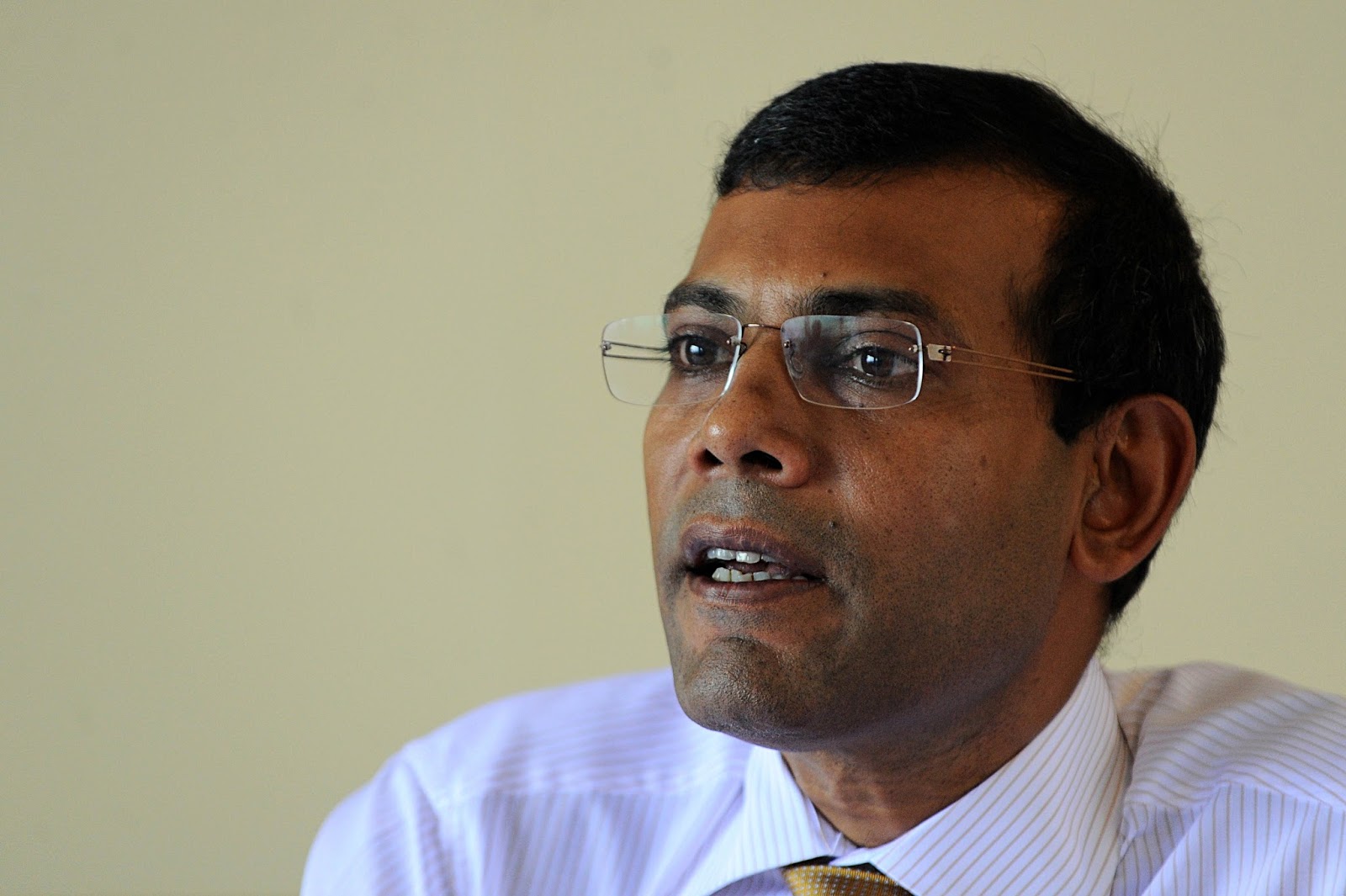

Heroism comes from courage and fighting for the truth. Nasheed, ex president of Maldives, is a champion of people's democratic rights. Mohamed Nasheed has fought several times and proved that he's our true hero. We present 10 reasons why he's considered hero for the island nation.
1. Nasheed has went to jail 20 times for democratic rights of people.

2. Nasheed is a champion of climate change activist.

3. Mohamed Nasheed is a people's President. He connects and communicate with common man like them.

4. He believes in justice, honest governance and democracy for nation.

5. No other leader met so many country's leaders in Copenhagen summit to save it's nation.

6. The way Nasheed speaks, not only holds conviction and truth but inspires us as well.

7. International communities and individuals are supporting him, shows his global influence.

8. He's famous as Mandela of Indian ocean and global President worldwide. Who else from Maldives earned such titles?

9. Nasheed may not have earned great power, but he has earned our respect and love .

10. Nasheed is people's future, a hope and champion of democracy, and many others reasons you're read this article and consider him a HERO.

1. Nasheed has went to jail 20 times for democratic rights of people.
2. Nasheed is a champion of climate change activist.

3. Mohamed Nasheed is a people's President. He connects and communicate with common man like them.
4. He believes in justice, honest governance and democracy for nation.

5. No other leader met so many country's leaders in Copenhagen summit to save it's nation.

6. The way Nasheed speaks, not only holds conviction and truth but inspires us as well.

7. International communities and individuals are supporting him, shows his global influence.

8. He's famous as Mandela of Indian ocean and global President worldwide. Who else from Maldives earned such titles?

9. Nasheed may not have earned great power, but he has earned our respect and love .
10. Nasheed is people's future, a hope and champion of democracy, and many others reasons you're read this article and consider him a HERO.
Subscribe to:
Posts (Atom)
Popular Posts
-
 Appointed as Ambassador of Maldives to Japan Former Presidential Affairs Minister Mohamed Hussain ‘Mundhu’ Shareef has been appoin...
 -
 There is a rumour going viral on social media that Maldivian Army top brass has expressed reservations about being drawn ...
 -
Abdulla Ameen, one of the most important minister from Yameen Government has won " transparency international honor of Politi...
-
 Bed-In for Peace Beatles legend John Lennon married his second wife Yoko Ono on March 20, 1969. Five days later, in lieu of a traditiona...
 -
1. The Occupy Movement (2011-present) A world-wide demonstration against the so called 1% and global social and economic ine...
-
 Ministry of Defence and National Security in Maldives has signed an agreement with India’s Lovely Professional University for co...
 -
 The Anti-Corruption Commission (ACC) has stated that investigations have revealed that Abu Dhabi’s association had made the donation ...
 -
 He remains a figurehead for the promotion of human rights and democracy in Islamic countries, and an international icon for ac...
 -
 Rumors in the power corridors are that Adheeb also conspiring to replace the Vice President. The theory is that VP is only amongst ...
 -
 Yameen, the great ruler, President of Maldives is ready for his crowning ceremony. This is happening first time in the history of t...